Industrial gases and dry ice require proper handling. This guide covers dry-ice safety, compressed-gas cylinder handling, cryogenic-liquid procedures, gas-specific hazards, emergency response, and how to obtain SDS documentation. Reviewed against OSHA, DOT, NFPA, and CGA standards.
Dry ice is solid carbon dioxide at -109°F (-78°C). Two principal hazards: contact frostbite and CO₂ asphyxiation in poorly ventilated spaces. Handled correctly, dry ice is safe for food packaging, cold-chain shipping, lab use, blasting, and special-effects work.
One pound of dry ice sublimates into roughly 8 cubic feet of CO₂ gas. Sealed containers will rupture or explode from internal pressure. Always vent.
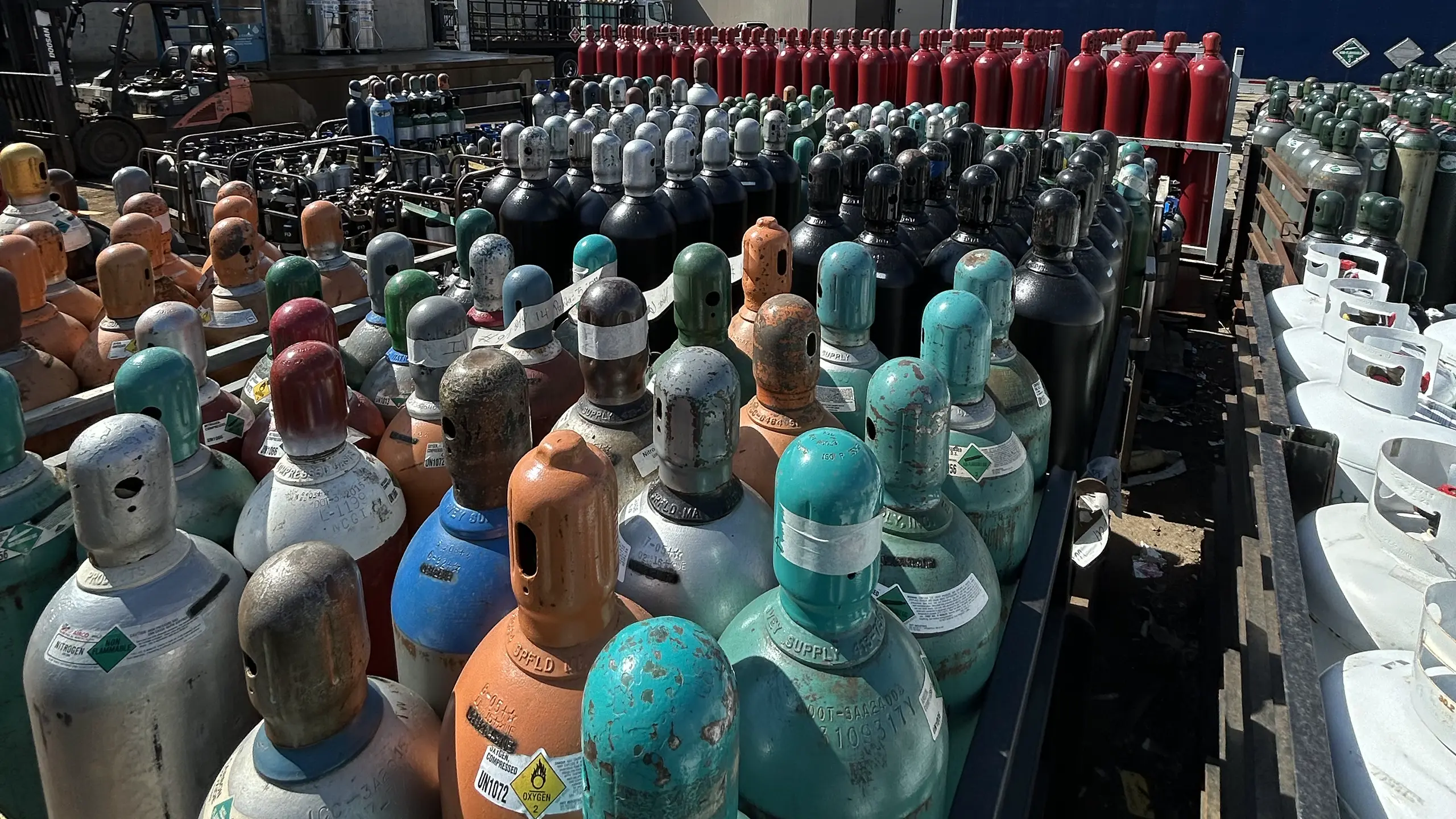
Compressed gas cylinders store gas at high pressure (often 2,000 – 3,000 psi). A damaged cylinder valve can turn a 150-lb steel cylinder into a projectile capable of penetrating walls. Always treat cylinders as potentially hazardous until secured, capped, and at rest.
Lying an acetylene cylinder on its side allows liquid acetone to enter the valve and downstream equipment. If a cylinder has been on its side, stand it upright for at least one hour per foot of cylinder length before opening the valve.
Cryogenic liquids — liquid nitrogen (-320°F), liquid oxygen (-297°F), liquid argon (-303°F), liquid CO₂ (-109°F to -69°F depending on pressure) — present cold-burn (frostbite), asphyxiation, and oxygen-enrichment hazards. Use only in approved Dewars and bulk vessels.
Each gas has a primary hazard class. Always reference the SDS for your specific product and grade — this table is a quick-reference summary, not a substitute for product-specific guidance.
| Gas | Primary Hazard | Density vs. Air | Critical Note |
|---|---|---|---|
| Oxygen O₂ | Oxidizer | Same | Supports combustion — keep away from oils, fuels, organics. Greases ignite spontaneously in oxygen-enriched atmospheres. |
| Acetylene C₂H₂ | Highly Flammable | Slightly lighter | Always store and transport upright. Reactive with copper, silver, mercury alloys. Use only acetylene-rated regulators. |
| Propane C₃H₈ | Flammable | Heavier | Pools in low areas — basements, trenches, vehicle floor pans. Strong odorant added; treat any propane smell as an emergency. |
| Nitrogen N₂ | Simple Asphyxiant | Same | Odorless, colorless, no warning signs. Use O₂ monitor in confined spaces. Liquid form: 1L LN₂ → 700L N₂ gas. |
| Argon Ar | Simple Asphyxiant | Heavier | Pools in low spaces (pits, manholes, ship holds). Cannot be detected by smell. Use O₂ monitoring in confined spaces. |
| Carbon Dioxide CO₂ | Asphyxiant + Toxic at high concentration | Heavier | Pools in low areas. At >5% causes headache; >10% causes loss of consciousness. Use CO₂ monitor in beverage and dry-ice storage. |
| Helium He | Simple Asphyxiant | Lighter | Rises and pools at ceiling level. Ventilate from the top. Inhalation displaces oxygen even briefly — never as a recreational gas. |
| Ammonia NH₃ | Toxic + Flammable | Lighter | Strong irritant; pungent odor at low concentrations. PPE required: respirator, gloves, eye protection. Ventilate immediately on any release. |
This table summarizes principal hazards for common gases. Custom blends, ultra-high-purity grades, and reactive specialty gases have additional product-specific hazards documented in their Safety Data Sheet. Request the SDS from us before first use.
Safety Data Sheets, certificates of analysis, and product specifications are available on request for every product we supply. OSHA's Hazard Communication Standard (29 CFR 1910.1200) requires SDS access for any chemical product in your workplace.
16-section document covering identification, composition, hazards, first aid, fire response, accidental release, handling, exposure limits, physical/chemical properties, stability, toxicology, ecological data, disposal, transport, regulatory info, and other information. Required for every chemical product under OSHA HazCom.
Lot-specific assay confirming purity grade, component concentrations, and lot traceability. Required for ultra-high-purity and calibration mixes. NIST-traceable documentation available on calibration mixtures.
General product data including composition, available container sizes, valve/CGA outlet, typical impurity levels, and typical use cases. Useful for engineering specs and equipment compatibility checks.
To request documentation, call (508) 257-1680 or send a request via our contact form with the product name, grade, and lot number (if known). We typically respond same-day during business hours.
Call dispatch for immediate questions or send a message and we'll respond within one business day with the documentation or guidance you need.
Route updates, pricing changes & safety bulletins — never spam.